"I DID NOT HAVE SEXUAL RELATIONS WITH THAT PROTOS V SEXBOT!"
The review version is a PDF.
If you don't already know, +Venger Satanis is currently one of the best roleplaying games writer focused on weird, horror, sleazy and old-school; both fantasy and scifi. Alpha Blue is a great game, and Girls Gone Rogue made it even better with so much more material to use. What will Universal Exploits add to this sleazy space setting? Let's find out!
The book is divided into two chapters, "Rules, tables and setting" and "Suggestions, scenarios, and extras". But before the actual content begins, we get to read a three pages long short-story, which is
I wasn't a fan of Alpha Blue art, Girls Gone Rogue was way better and now Universal Exploits has best illustration of the trio! There are pictures from the same artist I disliked in the main game, but they blend well with other styles and artists, as they are no more (crappy) majority. They work now way much better. And line art is awesome. A warning though, many of the pictures are x-rated and sexual in theme with full frontal nudity and sexual acts, but there are also plenty of other science fiction imaginary. The porn doesn't bother me, though. Sure the sexual images oversexualize women and there could be more naked, porny men, too for balance. Again, be warned, there are so many images from which social justice warriors would rip their asses half. There are also few colored pictures, which is a nice addition.
Venger's writing is eloquent as ever, so the reading experience is really good. Everything is explained well with great writing. Because Alpha Blue's rules are extremely minimal and simple, you learn the rules additions easily and quickly. And there are plenty of them with lots and lots of random tables. The rules additions really give more detail for the campaign.
The strength of Alpha Blue product line are the random tables. There are so many, and they are so different. Many are really useful, some just fun additions to weird days you might need one. And what is best of these random tables, they are really inspiring for stories. You can easily just collect all you Alpha Blue books and start rolling tables, taking notes, and soon you have an adventure done. And naturally, you can use these tables in middle of the game to spice up, or sex up, the action and scenes. Religions, desires, alien worlds, locations, events, planets... everything in tables!
But because Alpha Blue as whole is basically made of tables after tables, you should write down all the random tables and collect them into one big index, so you know what tables are in what sourcebook. Otherwise it could be overwhelming to remember all the available material, yet shuffle through all the books to find the right table for the situation (in all sourcebooks and main rulebook together there are random tables for almost any situation).
One great part is domain management. In old-school games, when you have adventured enough, it is time to invest your money on some land. In this sourcebook, you can do it in space!
Suggestions, Scenarios, And Extras gives you hints and tips how to run an Alpha Blue game. Venger is an awesome (Space) Dungeon Master (proof: How To Game Master Like A Fucking Boss) who doesn't hesitate to share his experiences how to make games... well... fucking awesome. This chapter has lots of actual game expamples and suggestions how to get players involved in adventures - and how to make them adventure. Universal Exploits is an adventurers' agency after all!
You also get adventures, but in my opinion they are not that handy to refer during the play and read more than explained short stories. They feel a little railroading also. There are plenty of them, though, and even if not fun to run (I cannot decide that for you, or even myself without actually running them!) they are good fiction of the Alpha Blue setting. Some of the adventures here are more a location, where stuff is going on. A nice addition.
In my opinion, Universal Exploits is a great sourcebook for any science fiction game with weird, gonzo and action. If your game is pornographic -or needs more porn- even better. If you strip all the naughty, you still have lots of great content to use in different scifi settings. Well worth the buck!
Also with the PDF you get separate files for the maps included in the book. They are absolutely brilliant. +MonkeyBlood Design has outdone himself.
One final warning. Because the product is filled with tables and content, PDF version of it might be slow to use in actual game, when shuffling the book is nicer and easier. Just my opinion.
__________________________________________________
Universal Exploits at RPGNow.
Alpha Blue at RPGNow.
Girls Gone Rogue at RPGNow.
Sleazy Space Opera (bundle of above three titles) at RPGNow.
My review of both Alpha Blue and Girls Gone Rogue HERE.
Reviews, articles, and material by an OSR enthusiast and a publisher.
Showing posts with label Reviews. Show all posts
Wednesday, 22 February 2017
Tuesday, 10 January 2017
[Review] The Blood Hack
Before I begin with the review, I want you to know, that I have had a privilege to work with this game. I did the layout, edited the text, made covers and a character sheet and discussed rules. But this review is not biased, because when I received the draft for this game, I fell in love. As I said, it was a privilege for me to get a change to work with The Blood Hack and its author +Matthew Skail.
I love The Black Hack. It takes my favorite rules system and tweaks it to simplier and more versatile form. Even though I still enjoy early D&D and OSR games, The Black Hack is something different, yet familiar. And because it is a versatile system, it is easy to reproduce for different genres, like Cyber-Hacked! which makes cyberpunk fun and fast or The Super Hack which makes super heroes not a chore, with roots to my favorite game(s).
In early 2000 I played Vampire: The Masquerade. I played it a lot! So much I grew sick of it for various different reasons. When I found OSR, I started to think what V:tM would be with OSR rules. When I found The Black Hack, I started thinking what playing vampires in World Of Darkness style campaign would be with it. Then at Google Plus I found out, that Matthew was working on a game using The Black Hack rules with a feel of 90s vampires and modern gothicpunk world.
And damned The Black Hack system works brilliantly with vampires!
You get the normal rules, where you roll everything under your Stats, be it fighting, different tasks or saving rolls. Because this game is set to a modern era, you also get rules for vehicles, firearms, chases and such, which all work great with the simple core mechanics.
There are four different vampire classes from four different Houses of the Blood. They are not just those four core fantasy races re-dressed with fangs, but great write-ups with different knowledges and skills. Each of them is great for different types of archtypes from magisters to warriors.
Vampires naturally have their supernatural powers, Gifts. They gain Gifts more experienced they get, and start with few. You are free to develop your vampire with Gifts you want to take, and are not restricted to bloodlines that determine your future gifts. The gifts are not only things that boost your vampire to be more powerful than human, they are many really clever and more towards roleplaying rather than rollplaying.
Some vampires can also learn rituals, which are blood powered powerful magic. There are five levels of ritual powers, from quite simple to truly horrific! The rituals are absolutely fantastic and don't feel that they are just replacing fantasy roleplaying game's spells. They are a different beast, and add extra flavor to the game.
The great thing is how the innovation of usage die is used with blood points and morale (basically humanity from V:tM). Instead of calculating and spending blood points like hit points, you roll usage die for blood for example when powering gifts or healing. Morale has an absolutely brilliant adaptation of usage die what really captures the downward spiral of vampire morality! Really elegant adaptation of the original system, where you used usage die for inventory items.
You also get lots of different NPC stats from commoners to supernatural beings. Many have special rules, which are simple, yet flavourful.
The Blood Hack has everything you need to begin playing in dark modern days as an undead vampire, who only doesn't struggle with her humanity, but also the dangers of the night. If you liked World Of Darkness games, this is a must have or you like The Black Hack, this is a great addition to your collection to mix with other "hack" genres.
Year 2017 has just started, but as an ex-Vampire fan and a big The Black Hack rules system fan, at this point I can already say, that The Blood Hack will be one of the greatest RPG products of this year.
You can get the PDF from RPGNow and print-on-demand will be released later.
Buy it HERE.
I love The Black Hack. It takes my favorite rules system and tweaks it to simplier and more versatile form. Even though I still enjoy early D&D and OSR games, The Black Hack is something different, yet familiar. And because it is a versatile system, it is easy to reproduce for different genres, like Cyber-Hacked! which makes cyberpunk fun and fast or The Super Hack which makes super heroes not a chore, with roots to my favorite game(s).
In early 2000 I played Vampire: The Masquerade. I played it a lot! So much I grew sick of it for various different reasons. When I found OSR, I started to think what V:tM would be with OSR rules. When I found The Black Hack, I started thinking what playing vampires in World Of Darkness style campaign would be with it. Then at Google Plus I found out, that Matthew was working on a game using The Black Hack rules with a feel of 90s vampires and modern gothicpunk world.
And damned The Black Hack system works brilliantly with vampires!
You get the normal rules, where you roll everything under your Stats, be it fighting, different tasks or saving rolls. Because this game is set to a modern era, you also get rules for vehicles, firearms, chases and such, which all work great with the simple core mechanics.
There are four different vampire classes from four different Houses of the Blood. They are not just those four core fantasy races re-dressed with fangs, but great write-ups with different knowledges and skills. Each of them is great for different types of archtypes from magisters to warriors.
Vampires naturally have their supernatural powers, Gifts. They gain Gifts more experienced they get, and start with few. You are free to develop your vampire with Gifts you want to take, and are not restricted to bloodlines that determine your future gifts. The gifts are not only things that boost your vampire to be more powerful than human, they are many really clever and more towards roleplaying rather than rollplaying.
Some vampires can also learn rituals, which are blood powered powerful magic. There are five levels of ritual powers, from quite simple to truly horrific! The rituals are absolutely fantastic and don't feel that they are just replacing fantasy roleplaying game's spells. They are a different beast, and add extra flavor to the game.
The great thing is how the innovation of usage die is used with blood points and morale (basically humanity from V:tM). Instead of calculating and spending blood points like hit points, you roll usage die for blood for example when powering gifts or healing. Morale has an absolutely brilliant adaptation of usage die what really captures the downward spiral of vampire morality! Really elegant adaptation of the original system, where you used usage die for inventory items.
You also get lots of different NPC stats from commoners to supernatural beings. Many have special rules, which are simple, yet flavourful.
The Blood Hack has everything you need to begin playing in dark modern days as an undead vampire, who only doesn't struggle with her humanity, but also the dangers of the night. If you liked World Of Darkness games, this is a must have or you like The Black Hack, this is a great addition to your collection to mix with other "hack" genres.
Year 2017 has just started, but as an ex-Vampire fan and a big The Black Hack rules system fan, at this point I can already say, that The Blood Hack will be one of the greatest RPG products of this year.
You can get the PDF from RPGNow and print-on-demand will be released later.
Buy it HERE.
Monday, 5 December 2016
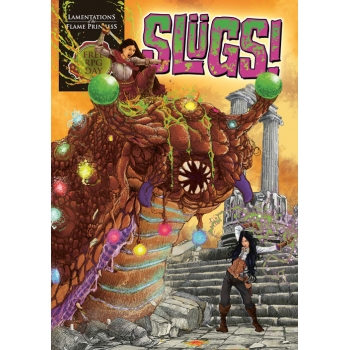
[Review] Slügs by Lamentations of the Flame Princess
Slügs was a free RPG day sourcebook, now available for everyone in print for a very reasonable price, and when they're all gone, a pay-what-you-want PDF will be released.
There are NSFW work included, but the quality of drawings is great. Kelvin Green's (Forgive Us) slüg drawings are great and he has captured the different qualities of the various slügs very well. Yannick Bouchard's inside covers are his usual great quality. And Rich Longmore's cover that expands to the back is very colorful.
Most of the LotFP publications are adventures or settings, few being sourcebooks (like Vornheim for city adventures or The Seclusium Of Orphone for creating mages' towers). LotFP doesn't believe in traditional monster books, as its weird fantasy philosophy is, that each creature/monster encountered should be unique instead of just something out from monster manual. Slügs is a compilation of monsters - slugs in this case - but they are all unique and individuals. Or that's the impression the text gives. You don't meet 10 "muscle slügs" (yes, they're there) guarding a treasure in a dungeon.
There are 16 different slügs in total, each different. Generally the aren't just meatbags and hit points for player characters to grind for experience and loot, they all have a gimmick or two - but the gimmicks are not stupid. Well, some of them are, like the christmas slüg what you get presents from if you're lucky, or breakfast slüg which is a slimy bowl of cereal. These slügs can be a big part of campaign, and a quest to find, for example the doctor slug to be found to cure horrible wounds and damage an adventurer party member has suffered. Some will make a quest, like mentallo slüg, who knows the future and wants you to prevent something horrible from happening. Some of them just have an effect, like sluggish slüg. But for those who want to fight horrible monsters, there are more traditional slügs like the vomit slug.
There are NSFW work included, but the quality of drawings is great. Kelvin Green's (Forgive Us) slüg drawings are great and he has captured the different qualities of the various slügs very well. Yannick Bouchard's inside covers are his usual great quality. And Rich Longmore's cover that expands to the back is very colorful.
Slügs was a fun read. There are many different slugs from which almost any Game Master can find something to throw into their campaign world. Many of them are humorous, some even stupid, but most of them are easily usable (the humorous and stupid depend on the players and campaign, rest don't that much). Even IF Slügs was just a big joke, you can use it without making your campaign just silly.
For the price of less than a dollar, when you order anything from LotFP strore, there is no excuse of not including this to it. I say, go get it!
Saturday, 22 October 2016
[Review] The Black Hack: Cyber-Hacked!
The Black Hack is fast and fun and D&D compatible fantasy system, which has already been hacked to fill a genre that I have not played yet (disclaimer: supers!). I have played both Shadowrun and Cyberpunk, 2300AD had a cybernetics sourcebook and I am pretty sure I've played GURPS cyberpunk stuff, too. So, cyberpunk in roleplaying games is not new for me. I've longed for a cyberpunk D&D. There are cyberstuff for OSR, but this is my first actual cyberpunk OSR D&D compatible game. Exciting!
Author +Mike Evans and illustrator +Alex Mayo are both cool guys with awesome gaming ideas and stuff. So this should be very, very good!
The PDF is 21 pages, with 18 pages of actual RPG stuff, including the character sheet. What I love in TBH is that you get a full RPG rules you learn to play while you eat a dinner before the game night begins. Like other TBH hacks, the layout is simple and apes the original. The only picture is on the cover. Very printer-friendly and space efficient, yet dull.
The rules are basically a carbon copy of TBH with few exceptions and additions that suit a modern genre. This starts to get annoying. Sure, you only need this to run the game, but now I am starting to get many, many copies of The Black Hack rules. It would be ace if the layout would be that when I'd print this, I could opt out all the basic and core TBH rules and only print the new stuff that is not already included in the original game. But it doesn't happen here. Small additional and new rules are scattered here and there within the text already in other hacks and the main game.
The most important new rules are full auto fire, which is simple. In many games when you shoot more than one shot the rules get wonky and slow. This is not the case here. Funny thing is, though, that two handed combat also affects guns you hold with two hands. But if you think about it, this is an elegant way in making bigger weapons more damaging, when the core mechanic is, that weapon damage is class based. Very, very clever!
Drugs are also easy. They give a small bonus, but you suffer disadvantage(s) under influence. Also addiction is as simple. Great! Taking drugs is fast and easy.
Vehicles and chases have also simple rules in the fashion of TBH. They are pretty good and should cover most of the situations. When a vehicle is shot enough, it is destroyed and there is a 50/50 chance can it be salvaged or not. Chase is a simple series of attribute tests, where you either gain or lose distance. Pretty boring, and it could take a long time to just roll after roll. There should be an extra rule for dangerous manouvres to gain more than 1 point of distance (starting from 5, 10 to escape, 1 to get caught). Manouvres are easily done, roll with disadvantage to gain double points. Still dull, but adds danger and story element (I try to steer to this narrow alley...).
One of the most important rules in a cyberpunk game is hacking. I think Cyberpunk 2020 is an awesome game, but the hacking part of it is extremely dull - and slow. Normal hacking in Cyber-Hacked is a simple INT test, but there is also more detailed rules, using die-drop table! You take a number of dice and drop them on a paper. The die type and value tell from a random table, what it is. Then connect them and voilá, you got a quickly generated data network to be hacked! All the stuff you do hacking you use usage die to do. When it's dropped to zero, you're booted. These hacking rules are fast, fun and brilliant!
You also get contacts who are basically people you can use as resources, and you can be either a human or a synthetic before you choose a class. There are 7 classes to choose from, including a psychic. The classes basically work like in TBH, they each have something special they do. In addition, they now are listed with starting equipment (you, I dislike buying normal gear for characters) and an interesting trinket. Some of these classes are modified from the basic classes, some are a bit different. I think every player should find their favorite easily from these.
Different kind of everyone other is Psychic, who can use his psychic abilities per day based on his level. These abilities are basically like spells in a fantasy game.
Equipment list is minimal, but enough. Cyberware has no special rules. You can have 4 of the (one character class being an exception) to gain some bonuses or other effects. That's it. No problems between a line where human ends and a machine starts. There could have been a little more to this, because now cyberware is just like equipment.
There's plenty of enemy stats to fight and use, but there could have been few more, because now the one page table doesn't reach the end of the page, but leaves an empty white space being short. This layout problem could have been fixed with more enemies! This is plenty already, but it just looks sloppy and lazy.
So, what do I think? This is very, very good in a The Black Hack good. TBH family products are DIY. A bit raw, but full of good ideas (WHEN THEY ARE GOOD, THAT IS) with simple and fun core mechanics. Even though it's dull to get same basic rules all over again, the additions to cyberpunk genre included in CYBER-HACKED are great. Inexpensive price, D&D compatible, fast to learn, fast to play... I see no reasons why everyone shouldn't get a copy. Even though you don't plan to play a campaign of CYBER-HACKED, you can keep this just in case, if someday, someone wants to play some cyberpunk in 10 minutes!
_____________________________________
You can buy the PDF from RPGNow.
Author +Mike Evans and illustrator +Alex Mayo are both cool guys with awesome gaming ideas and stuff. So this should be very, very good!
The PDF is 21 pages, with 18 pages of actual RPG stuff, including the character sheet. What I love in TBH is that you get a full RPG rules you learn to play while you eat a dinner before the game night begins. Like other TBH hacks, the layout is simple and apes the original. The only picture is on the cover. Very printer-friendly and space efficient, yet dull.
The rules are basically a carbon copy of TBH with few exceptions and additions that suit a modern genre. This starts to get annoying. Sure, you only need this to run the game, but now I am starting to get many, many copies of The Black Hack rules. It would be ace if the layout would be that when I'd print this, I could opt out all the basic and core TBH rules and only print the new stuff that is not already included in the original game. But it doesn't happen here. Small additional and new rules are scattered here and there within the text already in other hacks and the main game.
The most important new rules are full auto fire, which is simple. In many games when you shoot more than one shot the rules get wonky and slow. This is not the case here. Funny thing is, though, that two handed combat also affects guns you hold with two hands. But if you think about it, this is an elegant way in making bigger weapons more damaging, when the core mechanic is, that weapon damage is class based. Very, very clever!
Drugs are also easy. They give a small bonus, but you suffer disadvantage(s) under influence. Also addiction is as simple. Great! Taking drugs is fast and easy.
Vehicles and chases have also simple rules in the fashion of TBH. They are pretty good and should cover most of the situations. When a vehicle is shot enough, it is destroyed and there is a 50/50 chance can it be salvaged or not. Chase is a simple series of attribute tests, where you either gain or lose distance. Pretty boring, and it could take a long time to just roll after roll. There should be an extra rule for dangerous manouvres to gain more than 1 point of distance (starting from 5, 10 to escape, 1 to get caught). Manouvres are easily done, roll with disadvantage to gain double points. Still dull, but adds danger and story element (I try to steer to this narrow alley...).
One of the most important rules in a cyberpunk game is hacking. I think Cyberpunk 2020 is an awesome game, but the hacking part of it is extremely dull - and slow. Normal hacking in Cyber-Hacked is a simple INT test, but there is also more detailed rules, using die-drop table! You take a number of dice and drop them on a paper. The die type and value tell from a random table, what it is. Then connect them and voilá, you got a quickly generated data network to be hacked! All the stuff you do hacking you use usage die to do. When it's dropped to zero, you're booted. These hacking rules are fast, fun and brilliant!
You also get contacts who are basically people you can use as resources, and you can be either a human or a synthetic before you choose a class. There are 7 classes to choose from, including a psychic. The classes basically work like in TBH, they each have something special they do. In addition, they now are listed with starting equipment (you, I dislike buying normal gear for characters) and an interesting trinket. Some of these classes are modified from the basic classes, some are a bit different. I think every player should find their favorite easily from these.
Different kind of everyone other is Psychic, who can use his psychic abilities per day based on his level. These abilities are basically like spells in a fantasy game.
Equipment list is minimal, but enough. Cyberware has no special rules. You can have 4 of the (one character class being an exception) to gain some bonuses or other effects. That's it. No problems between a line where human ends and a machine starts. There could have been a little more to this, because now cyberware is just like equipment.
There's plenty of enemy stats to fight and use, but there could have been few more, because now the one page table doesn't reach the end of the page, but leaves an empty white space being short. This layout problem could have been fixed with more enemies! This is plenty already, but it just looks sloppy and lazy.
So, what do I think? This is very, very good in a The Black Hack good. TBH family products are DIY. A bit raw, but full of good ideas (WHEN THEY ARE GOOD, THAT IS) with simple and fun core mechanics. Even though it's dull to get same basic rules all over again, the additions to cyberpunk genre included in CYBER-HACKED are great. Inexpensive price, D&D compatible, fast to learn, fast to play... I see no reasons why everyone shouldn't get a copy. Even though you don't plan to play a campaign of CYBER-HACKED, you can keep this just in case, if someday, someone wants to play some cyberpunk in 10 minutes!
_____________________________________
You can buy the PDF from RPGNow.
Friday, 23 September 2016
[Review] The Super Hack
This is the first superheroes hack (as far as I know) for the popular phenomenom called The Black Hack (my review). TBH is so popular, because the rules are super lite still being very old-school compatible with Dungeons & Dragons, and it is easy, you guessed right, to hack!
There has been several different hacks for TBH core game with variable quality. Some are awesome, some feel just that they're made for easy money to milk from a popular brand (core rules copy pasted only a thing or two of addition).
Before I go to the actual review, I must say that I have not played superhero roleplaying games. Ever! I did own True20 powered Mutants & Masterminds 2nd Edition, which had a great amount of powers which worked great for character creation and concepts, but point buy character creation was a turn off, especially when you had to use a pool of points to buy everything from stats to gear! I hate that kind of stuff. At the moment in my collection I have Champions 4th Edition, but it is very thick and looks so boring, I've never read it more than a couple of sentences at once! That's no thanks for me.
As a big fan of The Black Hack, which I have ran several times and have played a couple of times and had tons of fun with it always, I am very enthusiastic of this product. Easy and versatile system and the page count is not intimidating at all: the PDF clocks at 20 pages, with 16 pages of actual content (one of those being a character sheet and another a play example, so there's 14 pages of rules and material).
Visually The Super Hack imitates the original source. Instead of ink drips on pages, there are low-ish resolution cracks. The core mechanics of the game are explained clearly, as is character creation. Even better than in the original game! Because this is a superhero game, you choose superpowers determined by your class of choice with some freedom. You can also pick one superpower more than once to juice it up. Characters start with two pieces of (special) equipment, a costume and a secret identity. The equipment list is extremely short, only 12 items! There should be more of them, at least 20 to make at least a decent random table. Items have special rules, which are pretty good and usage die is well thought and adapted in many cases.
The rules are quite similar to The Black Hack, but there are minor differences. One is proficiency, which I don't understand at all. If character uses or wears and equipment that is not appropriate for her class or superpowers, they add their Protection Points to any rolls to attack or avoid damage with a disadvantage. But there are no guidelines what gear is inappropriate to what class or superpower. In addition the rule is stupid; more powerful you are to protect yourself, the crappier you are at using some stuff. Weird and not making any sense to me. If someone can explain this to me...
Majority of other rules are a carbon copy from The Black Hack. A great addition is a sub-table for Out Of Action, called This Is Serious. I really, really like this one! In format one weird thing is, that enemy HD are listed under Initiative section.
There are four different superhero classes, which are quite stupid. They should be more broad and cover different types of heroes. Crimefighter is silly, because aren't all superheroes crimefighters in a way or another. Other's are like a Warrior from the original game without extra attacks, and a Thief who is just good at shooting getting also Warrior's extra attacks. And then there is a guy with just very good saves. Character classes are not that good, they are unimaginative and don't represent different hero stereotypes as they should.
When characters level up, they can in addition to possible attribute increaswes also develop their superpowers further, which is nice. Superpowers have a better effect (actually this is the same table as The Black Hack's damage table). They also have an usage die, which is regained after a rest. There are 20 superpowers (two with variations, so actually 22) and the list is quite nice covering all kinds of powers to combine to create an unique superhero.
There is also a rule, that with advantages and disadvantages (roll 2d20, and pick better/worse), GM can also apply modifiers (this rule wording didn't meet editor's eyes, it's super wonky) which basically change the simple idea of advantages and disadvantages backwards to modifier calculation. Unnecessary addition to The Black Hack rules.
Instead of "Armor Points" characters have "Protection Points", which basically is the same thing; damage reduction that is refilled after rest. One fun thing in combat is that a group of thugs represents one hit die point per a good - so when you score 5 points of damage, you actually stun (superheroes don't kill people, do they?) 5 of the enemies! Very, very fun detail, where you can feel your character's power compared to ordinary thugs! There are only seven different example baddies included, which should be enough for an example, because in super games most of the bad guys and gals are unique anyways.
In my opinion The Super Hack is hastily put together, yet a fun and good little addition to "The Hack" family. There are minor flaws, but they are so puny that they don't make the game bad. Only major problem I have with this game are character classes. Only one of these (The Brick) is good as a heroic stereotype, rest are not at all. With better character classes this would have been super awesome! Now it is "only" super good. Revised edition with better classes would be the bomb! Before that happens (if ever), I need to hack this myself and print it out.
Oh, and in the end the example play scenario is fun and inspiring, even though there could have been a wider variety of game mechanics used in it.
Do I recommend it? Yes! The Black Hack is great fun little system easy to just play and have fun with, and The Super Hack is quite as good, only if you make the classes better yourself. If you like superhero games, this is a pocket version of the genre. If you don't own any superhero games, this is an inexpensive place to get one.
Get it from RPGNow, available in both PDF ($2.00) and print-on-demand ($6.00).
__________________________________________________________________
EDIT 09/25/2016:
I've had discussed with the author, and here are his responses to two points that rubbed me the wrong way, the PP affecting inappropriate equipment use and the character classes. Simon Purley wrote:
There has been several different hacks for TBH core game with variable quality. Some are awesome, some feel just that they're made for easy money to milk from a popular brand (core rules copy pasted only a thing or two of addition).
Before I go to the actual review, I must say that I have not played superhero roleplaying games. Ever! I did own True20 powered Mutants & Masterminds 2nd Edition, which had a great amount of powers which worked great for character creation and concepts, but point buy character creation was a turn off, especially when you had to use a pool of points to buy everything from stats to gear! I hate that kind of stuff. At the moment in my collection I have Champions 4th Edition, but it is very thick and looks so boring, I've never read it more than a couple of sentences at once! That's no thanks for me.
As a big fan of The Black Hack, which I have ran several times and have played a couple of times and had tons of fun with it always, I am very enthusiastic of this product. Easy and versatile system and the page count is not intimidating at all: the PDF clocks at 20 pages, with 16 pages of actual content (one of those being a character sheet and another a play example, so there's 14 pages of rules and material).
Visually The Super Hack imitates the original source. Instead of ink drips on pages, there are low-ish resolution cracks. The core mechanics of the game are explained clearly, as is character creation. Even better than in the original game! Because this is a superhero game, you choose superpowers determined by your class of choice with some freedom. You can also pick one superpower more than once to juice it up. Characters start with two pieces of (special) equipment, a costume and a secret identity. The equipment list is extremely short, only 12 items! There should be more of them, at least 20 to make at least a decent random table. Items have special rules, which are pretty good and usage die is well thought and adapted in many cases.
The rules are quite similar to The Black Hack, but there are minor differences. One is proficiency, which I don't understand at all. If character uses or wears and equipment that is not appropriate for her class or superpowers, they add their Protection Points to any rolls to attack or avoid damage with a disadvantage. But there are no guidelines what gear is inappropriate to what class or superpower. In addition the rule is stupid; more powerful you are to protect yourself, the crappier you are at using some stuff. Weird and not making any sense to me. If someone can explain this to me...
Majority of other rules are a carbon copy from The Black Hack. A great addition is a sub-table for Out Of Action, called This Is Serious. I really, really like this one! In format one weird thing is, that enemy HD are listed under Initiative section.
There are four different superhero classes, which are quite stupid. They should be more broad and cover different types of heroes. Crimefighter is silly, because aren't all superheroes crimefighters in a way or another. Other's are like a Warrior from the original game without extra attacks, and a Thief who is just good at shooting getting also Warrior's extra attacks. And then there is a guy with just very good saves. Character classes are not that good, they are unimaginative and don't represent different hero stereotypes as they should.
When characters level up, they can in addition to possible attribute increaswes also develop their superpowers further, which is nice. Superpowers have a better effect (actually this is the same table as The Black Hack's damage table). They also have an usage die, which is regained after a rest. There are 20 superpowers (two with variations, so actually 22) and the list is quite nice covering all kinds of powers to combine to create an unique superhero.
There is also a rule, that with advantages and disadvantages (roll 2d20, and pick better/worse), GM can also apply modifiers (this rule wording didn't meet editor's eyes, it's super wonky) which basically change the simple idea of advantages and disadvantages backwards to modifier calculation. Unnecessary addition to The Black Hack rules.
Instead of "Armor Points" characters have "Protection Points", which basically is the same thing; damage reduction that is refilled after rest. One fun thing in combat is that a group of thugs represents one hit die point per a good - so when you score 5 points of damage, you actually stun (superheroes don't kill people, do they?) 5 of the enemies! Very, very fun detail, where you can feel your character's power compared to ordinary thugs! There are only seven different example baddies included, which should be enough for an example, because in super games most of the bad guys and gals are unique anyways.
In my opinion The Super Hack is hastily put together, yet a fun and good little addition to "The Hack" family. There are minor flaws, but they are so puny that they don't make the game bad. Only major problem I have with this game are character classes. Only one of these (The Brick) is good as a heroic stereotype, rest are not at all. With better character classes this would have been super awesome! Now it is "only" super good. Revised edition with better classes would be the bomb! Before that happens (if ever), I need to hack this myself and print it out.
Oh, and in the end the example play scenario is fun and inspiring, even though there could have been a wider variety of game mechanics used in it.
Do I recommend it? Yes! The Black Hack is great fun little system easy to just play and have fun with, and The Super Hack is quite as good, only if you make the classes better yourself. If you like superhero games, this is a pocket version of the genre. If you don't own any superhero games, this is an inexpensive place to get one.
Get it from RPGNow, available in both PDF ($2.00) and print-on-demand ($6.00).
__________________________________________________________________
EDIT 09/25/2016:
I've had discussed with the author, and here are his responses to two points that rubbed me the wrong way, the PP affecting inappropriate equipment use and the character classes. Simon Purley wrote:
"In terms of rules - it's TSH version of TBH having different character classes being limited to specific types of armour. I couldn't limit the character classes as rigidly as he did in TBH but I wanted it in somewhere."
"In terms of genre - It means to stop people buying Superpowers. The first ever SHRPG Superhero 2044 had a "Superhero shop" and, as soon as they made money, people went and bought weapons and armour and flight rings etc. The game just didn't resemble the comics. Basically why doesn't Captain America take out Iron Man, steal his armour and put it on? If he did, he wouldn't know how to use it."
"BTW: The character classes are Superhero tropes. The Brick is your classic brawler (The Hulk, The Thing, Luke Cage). The Blaster is your classic ranged attacker (The Human Torch, Cyclops). The Crimefighter is your classic human who can go toe to toe with the super types (Batman, Captain America, Daredevil). The unique is your weirdos (The Vision, The Sacrlet Witch, Jessica Jones)."
"A design choice I went for in TSH was to keep the rules stripped down without loads of explanation or examples - in keeping with the philosophy of TBH. When I moved from PDF to print it created a couple of extra pages which I could have used for more explanation or example scenarios ("Superheroes vs. dinosaurs" doesn't take much space to explain.) It was a definite choice not to do so"
Saturday, 6 August 2016
[Review] Alpha Blue + Girls Gone Rogue
| Get it from RPGNow, both PDF and POD! |
ALPHA BLUE is a sleazy science fiction roleplaying game cheering 70's weird scifi and exploitation entertainment. In Alpha Blue interalienracial sex, drug abuse and killing stuff is perfectly normal - and acceptable. Because Alpha Blue is a space bordel!
But what can you do in this space station of sin except have dirty adventures? Quite a lot, in fact!
Even though Alpha Blue is about sex, it is a real game. And a good game too. You might get best of the setting if you keep the sex, drugs and sleaze, but don't make it the focus of the game. You can play space action adventures with sleaze vibes. That's how you can make Alpha Blue a blast! Remember the sleaze, but don't make this game full of it making it a dirty joke. Make it awesome!
If you are already familiar with +Venger Satanis' writing style, you know what to expect. It's like Venger is telling you all these cool ideas, maybe not organized, but clear. His enthusiasm comes across the text. It is friendly, but guiding. There are no dull moments reading Kort'thalis Publishing's products.
I mentioned that it might be not organized that well. It's because there is so much material in the product. Mostly fluff and random tables. And oh boy there are many random tables making this book quite useful even outside of Alpha Blue station! You get all kinds of fun things for character creation like how he dresses and what his signature weapon is. And naturally if you're an alien, what kind of an alien you are from appearance to customs. Other tables are really useful for running adventures.
Alpha Blue is mainly a setting, and easily compatible with any system you want to run it with. But there are light rules included, which are quite fun. Characters have no stats and all difficulties of rolls are determined by who the character is (not what his numeric stats are) and what the overall situation is like. More important is what kind of sex your character likes than how hard he can hit an opponent!
Extras are two character sheets, other darker version and a map of a single floor of Alpha Blue station spread on four pages. It would have been cool if it was pre-numbered so you could fill it easier yourself, as there are locations in the book, but they are not marked on the map. Alpha Blue is supposed to have several floors, but one pre-made floor would have been fun so you could get the gaming on straight ahead. Now you have to map the place before playing the game. Small wrinkle, nothing huge!
Illustration... ehm, I don't like it. Overall it's not quite good. Half of the images are decent and give an idea what Alpha Blue is like, but some pictures are lame; example a person who looks like Doctor Who with two women. Needless to say, there is lots of nudity, partial and full. One other complaint is that men and women are not sexualized equally - there are more naked women than men. Kort'thalis' overall sexual imaginary is quite masculine. It would be cooler if there were more stronger women in illustration and fiction. I am a heterosexual guy who does enjoy strong women too, not always those slaves in golden bikini...
Also there could have been more adventure examples and seeds on what happens at Alpha Blue space station bordel. Now there are only few, and most of those happen outside of the station. Oh why...
Overall Alpha Blue is a great rpg product, if you are not too sensitive for sleazy adult themes. You get lots of random tables to use, a detailed location and light rules. If tentacle sex and drugs you are okay with, you should check Alpha Blue out! If you want to know how people have ran Alpha Blue, here is a Google search done for you: ZAP!
| Get it from RPGNow, both PDF and POD! |
GIRLS GONE ROGUE is an expansion for Alpha Blue. You don't necessarily need it, but it sure makes the game 1000% better! The pdf is 80 pages of everything! Character creation and options are expanded. There are more little rules like dueling and ship to ship combat. There are more random tables, all kinds of them for so many different situations. You also get quite a few adventures. And tables to create planets. And now the illustration is from the same to better to great!
Girls Gone Rogue makes Alpha Blue better in so many ways expanding it to a full throttle to run campaigns. There is so much material combined in these books, that you will never run out of adventuring ideas and random tables.
Mark my word, even without sex Alpha Blue (and Girls Gone Rogue) is/are a great game full of fun and useful material. If you don't like sleazy themes, just drop them and enjoy space adventures! Illustration... well, you just have to deal with it :)
Tuesday, 19 April 2016
[Review] Pile of Matt Jackson's (Chubby Monster Games) products reviewed
I have quite a few products from +matt jackson I review now. Matt Jackson is a great rpg cartographer, but he also writes awesome material. You can check out what coolness he has to offer at his blog, too. His material is OSR compatible. Here are his publications reviewed, that I own:
Kanthor's Den
Get it from RPGNow.
This adventure location is easy to throw in on your campaign on almost any fantasy setting you are running. Adventurers might want to help the people out, get rid of monsters being monsters or for cash. This adventure is encounter based, so it does not only read easy, but is also easy to run. There are four encounters where one is a dungeon and the final is the conclusion. Even though the dungeon is short, it is an exciting location to explore. Players might advance to slay every monster, but sometimes not every monster is wise to slay...
Well written, fun, short, easy to throw in with minimum preparation. Perfect to be around for those game nights when the main campaign for a reason or another doesn't advance as it should.
Moleskin Maps Volume One - Five
Moleskin Maps are collections of different kinds of maps for you to use in your campaigns. Each volume contains 10 different maps and every map comes with an extra page where you can fill all the information to make an adventure location of your own. You get to develop the location name, background, key locations within, wandering encounters and treasure, not to forget personalized Game Master's notes.
These are great packets for those who like to build up their own adventures, but lack of mapping skills. Well, because Matt's maps are gorgeous, even mappers can enjoy them and only fill in the blanks. Dungeons, ruins, buildings, villages and wilderness are waiting for your creativity!
Side Treks 01: The Crossroads Of Spyley
Get it from RPGNow.
The Crossroads Of Spyley is a small location traveler's could rest at and fill in their equipment. Characters are easy to get to this location, not only because there is The Forest of Ruins nearby (not fleshed out, but you can throw all kinds of short adventures and dungeons there), but also because there are three adventure hooks to get to Spyley included.
These are the small products that come in handy. When you need a place, that is not a big town, in the middle of nowhere or along the way, this is a great product.
Side Treks 02: The Village Vol I.
Get it from RPGNow.
As the first Side Treks is a small location of three houses, the second one is a little bit larger; a tiny village this time. All five houses are well described and come with color maps. What I like, there are many random tables, for example stables have tables for what type of steeds are currently available and is the steed broken or not. In the village there are also fairies for sale, and more!
All maps came also in black and white for those who don't want to print in color.
Conclusion...
I say this once more: Matt Jackson draws great maps, and his writing is great. All his products are small in size and content making them easy to throw in your campaign as additional material or filler. I can recommend all of them, but you can for sure find what you are looking for. If you want to write dungeons and content, you have blank maps to do that. You also get a small filler adventure, or locations to use for characters to interact in.
Matt's stuff are a no brainer. Affordable price combined with high quality and many, many 5-star reviews make Chubby Monster Games products a great addition to your Game Master's folder of sweet material.
Tuesday, 29 March 2016
[Review] The Black Hack
The Black Hack pdf can be bought from RPGNow.
The Black Hack is an OSR game inspired by 70's original rules and a result of very successful Kickstarter. I was going to review this immediately after getting the pdf reward, but decided to postpone, as the first version was really unsatisfying and they were going to update it soon. Now that I have the new(est) version of The Black Hack, I am ready to review it, as many of the flaws I (and probably many others) had pointed out to the creator.
With The Black Hack you get a simple system with unified mechanics across all the things you want to do in a roleplaying games. With familiar six attributes from Dungeons & Dragons, you roll under for skill checks (attribute checks), to attack, to avoid being attacked, and to save versus various effects and dangers. Basically this means you don't need all kinds of attribute modifiers and sub-systems. Everything is d20 roll under. That is simple, and quick, and even though it reduces every bit of attribute bonuses and usages and sub-systems and whatever downgrading the game into extremely simple one-rail system actually downgrading into the core simplicity of original alternative attribute test rule, it is extremely innovative. You get to keep the old-school feel and high compability with other OSR games' stats with a different kind of a system. This is what is great with OSR: Whitehack is different from Labyrinth Lord which is different from Basic Fantasy which is different from The Black Hack, yet all these different systems are highly compatible with six same attributes with same ranges, and with AC and HD. Even though AC is different from damage reducing to ascending to descending, you can easily convert them around.
Being a different game with similar stats really makes The Black Hack stand out in the crowd of clones. You get D&D feel with different rules. And there is a reason to use these rules, if you want something simple, easy, and quick, but still want to play D&D.
One innovative thing is also penalties from example armor. If you are not proficient in armor you wear, you add the armor's protection value to your roll under roll result. The better (higher points) your armor is you are not proficient with, more likely you fail the task tests. Great! There is one problem with armor, though. Armor points reduce as much as they reduce the damage taken, until you rest. The explanation is, that the character is too tired or wounded to use the armor efficiently before resting. I find this a bit unsatisfying, when a leather armor protects you from 2 points. That is less than average damage from an attack dealing 1d6 of damage, and half of dagger (1d4) attacks make your leather armor using too demanding... Deadly, and makes armors one-hit-protectors. Advantage is that you cannot be this knight in a tin can no one can hit, but disadvantage is that armor makes little difference.
Instead of different save values for different things like poison or wands, you roll under your attribute to save. This is great! All attributes are equally important, not only to bend bars and sneak, and attack, but also for this! In other games save score is attached to character's class and level. When you level your save gets better. In The Black Hack when you level (no experience points, you level after a session or adventure, or when Game Master decides), you try to roll higher than your attribute score to raise it. Similar system you can find in Call Of Cthulhu for skills. And I like it; the better/higher your attribute is, harder it is to increase and develop it!
Two-handed weapons, critical damage, and effects of dropping below 0 HP are all discussed, which are not necessarily covered in original edition(s) or other OSR games. There's even an advantage/disadvantage system similar to Dungeons & Dragons 5th edition presented.
Inventory rules are what I like a lot, thanks to Lamentations Of The Flame Princess, where instead of weight you consider sizes. Innovation in The Black Hack is usages. Instead of keeping track of how many items you own of a certain type, you track usage dice. Roll 1-2 on a die, and it drops to one category lower. This is brilliant!
The four basic classes even with not that much technical data are different from each other, which is naturally good. There are no races, but I don't mind. The Black Hack can very well be grittier human-only monsters-are-monsters-not-your-friendly-companions.
There are few changes to magic rules. Usually slots you memorize spells in are slots you can cast spells "from". So if your character has two first level slots and one second level slot (third level cleric - this is basically the table found in other OSR games to determine how many spells your caster can memorize per day). When casting a spell and a save is failed, you reduce one spell slot of corresponding level of the spell. So, you can cast lots of spells and only a failed save cuts back your daily spell casting limits. You can cast directly from a book or memorize spells to automatically cast them without referring to that clumsy old tome. The text in spells section is a bit unclear, so I hope I understood it correctly.
Spell descriptions are short, but enough. Same with monsters. Even though they are (now) arranged in descending HD order, the monsters of same HD are not in alphabetical order. Frustrating flaw. HD 3 monsters are listed in this order:
Bugbear, Harpy, Wererat, Shadow, Doppleganger, Wight.
A small flaw, but annoying.
Character sheet is neat. It would be awesome in all it's minimalistic glory only if "spells" section was more useful. Many games have a sucking spells section in their character sheet.
Last page is an example of play. It is not that bad giving all kinds of different situations how to use rules, but it is plagued with typos.
ORIGINAL FLAWS
- Poor editing (somehow edited)
- Text a bit unclear at times (lots of inprovement)
- Chapters badly organized (quite the same)
- No spell list (added)
- Monsters in random order instead of alphabetic or HD (organized with HD)
- Banishing undead written so that you roll for each individual undead (fixed to groups of undead)
Biggest problem for me was the abstinence of spell list. The author explained, that you can get the spells from any of other games, so he didn't want to increase the page count with them. My argument was, that as The Black Hack is a small game and would be a stand-alone game with spells, it would be extremely stupid to carry a big hardcover (or whatever edition and version you take spells from) with a small game like this. My suggestion was to make spell list like in Tunnels & Trolls earlier editions, or like the monster entries, one liners.
Now as there are spells, this can be used as a complete game and you don't need to carry your big bulky PHB (or whatever rules with spells) with you to actually use The Black Hack.
Original score would have been:
4/5 for cool ideas and house rules
2/5 as a full game
Score for current edition 1.1.
4/5 for being a full game with neat ideas and simple playability
Saturday, 9 January 2016
[Review] Skullfuck zine #1 (might be NSFW theme)
I received a new zine from Necropantsed Publishing, +Victor Garrison. And man, what I got! This is so awesomely punk! Paper quality sucks, which is a nice detail. Also most of the zine is handwritten making it quite unique artifact in the ages of digital home publishing.
And the punk doesn't end there. If you dig extreme metal and punk aesthetics, this zine is made for you.
There is cursing, grotesque, not safe for work art, all in bad, but oh so delightful taste. If you like bands like GWAR or movies like Braindead/Dead Alive, this is what you need!
I won't spoil the content of this 8 page zine. You need to enjoy this with your own eyes.
This was one of the best things of 2015 and will be one of the best things of 2016! Period.
Sunday, 13 December 2015
[Review] Monstrous Miscellany #01
4Monstrous Miscellany #01 is (currently) James Mishler Games' newest publication. You can get it from RPGNow for under a buck!
In this pdf of 7 pages after cover page, OGL and all that you'll get four new monsters for Labyrinth Lord. Each of the monsters is exactly one page (8,5x11 inch), so they are easy to print to use. There is no illustration of any kind. But the lack of images doesn't matter, as the written descriptions are clear and evocative to give you the picture of these monsters.
The monsters are quite different and very higher fantasy with a little darker or fairy-taleish tone. You'll get a demon, a giant, a pixie, and an angelic creature. The hit dice vary a lot and cover basic to expert level characters' levels 13 being the highest.
With each monster you get basic description, organization, ecology and the usual like treasure and special powers. Descriptions are clear, if not a bit wordy.
Even though the creatures are different and doesn't seem to have a theme, I'd like to use them all in one campaign and make a theme around them. They have something similar, and that's something from what a single author does. James' own style.
$0.99 and four monsters, that's $0.25 a pop. Not bad. But is four monsters enough in a product when there are so many completed monster manuals around? I'd say yes, because even though there are dozens of great monster manuals for all these different games and systems and settings, small products like these easily highlight the monsters written in, instead of those 100+ monsters in one product. Usually I can also focus better on few monsters (which also might have more text in smaller products).
How'd I use this? Print the monsters, put them in a campaign folder, and make them fit. Easy to get new monsters for players, easy to use, easy to choose.
Even though I like weirder and more amazing or unique or grotesque or gonzo monsters, it is still refreshing to see something more fantastic in nature. That's why I liked this a lot. And hey, you can never have too many monster resources around... even if I don't use them all, I enjoy reading them! Well written and evocative and interesting monster descriptions are like short stories.
In this pdf of 7 pages after cover page, OGL and all that you'll get four new monsters for Labyrinth Lord. Each of the monsters is exactly one page (8,5x11 inch), so they are easy to print to use. There is no illustration of any kind. But the lack of images doesn't matter, as the written descriptions are clear and evocative to give you the picture of these monsters.
The monsters are quite different and very higher fantasy with a little darker or fairy-taleish tone. You'll get a demon, a giant, a pixie, and an angelic creature. The hit dice vary a lot and cover basic to expert level characters' levels 13 being the highest.
With each monster you get basic description, organization, ecology and the usual like treasure and special powers. Descriptions are clear, if not a bit wordy.
Even though the creatures are different and doesn't seem to have a theme, I'd like to use them all in one campaign and make a theme around them. They have something similar, and that's something from what a single author does. James' own style.
$0.99 and four monsters, that's $0.25 a pop. Not bad. But is four monsters enough in a product when there are so many completed monster manuals around? I'd say yes, because even though there are dozens of great monster manuals for all these different games and systems and settings, small products like these easily highlight the monsters written in, instead of those 100+ monsters in one product. Usually I can also focus better on few monsters (which also might have more text in smaller products).
How'd I use this? Print the monsters, put them in a campaign folder, and make them fit. Easy to get new monsters for players, easy to use, easy to choose.
Even though I like weirder and more amazing or unique or grotesque or gonzo monsters, it is still refreshing to see something more fantastic in nature. That's why I liked this a lot. And hey, you can never have too many monster resources around... even if I don't use them all, I enjoy reading them! Well written and evocative and interesting monster descriptions are like short stories.
Tuesday, 10 November 2015
[Review] How To Game Master Like A Fucking Boss
![]() |
| Image from Geeknative. |
"As you've probably noticed, I'm not abbreviating the title as you would expect. And I won't for the vast majority of our journey together. That's because it's a high office that deserves the utmost respect. In fact, I want you to temporarily wipe "GM" from your vocabulary. From now on, you're going to refer to the generic running and refereeing of roleplaying games as Game Master, Game Mastering, and Game Mastery. Don't minimize your vocation with a two-letter abbreviation.
Why? Because what we do requires a strong belief in ourself."Before I even start the review, I strongly advice you to buy the printed book version. The pdf is nice, sure, but this would be so much better as a book. Why? Personal notes. +Venger Satanis tells you how to be the best, or how to pursue to be the best Game Master (!!) in the world (or as good as you can be), so you should make this book your own. Read it, read it again. Learn from it. Adapt it. Get new ideas. Grow as a Game Master. I received this pdf for free, because I asked for it - even before the Kickstarter was done! I will buy the book for sure. PDF is nice, too, because you can print handy stuff easily... to that, later.
When I started reading this book (pdf) I was a little sceptical. The title is arrogant, but provocative. I thought, that this is a book where Venger will tell how much he is better than everyone else and how he will tell you what to do to be a better Game Master. Part of that is true.
The book is written damn well. It sucked me in. Venger writes, like this was a journal. He is telling what he does. And why. As this started as personal notes for self he thought to share, the writing style makes sense. But it is well written. It's like Venger is actually telling you his tricks of Game Mastery.
There are several dozen short chapters of different topics. These chapters are short, easy to read, and easy to digest. The topics revolve around Swords, Science, and Sorcery genre, but the main instructions are easy to adapt into any genre or gaming experience. Every chapter is indexed, so they are easy to find.
What is awesome, that there are examples and inspiration everywhere. As you continue to read, from examples you can literally get awesome campaign and adventure ideas on the go. Venger has this own dark fantasy world (links to his other products in the end, worth to check out) what lives through the text. Literally you could use this book to create a setting, after you filter all the example and idea bits.
But when you've read this once to get a grip of it and the second time to actually make notes, is it used and easily forgotten? Well, it depends how often you come back to a book. And how much you want to use Venger's tactics. I think you could check out some chapters every now and then, especially when your game is going to a direction discussed in this, but there is also more.
The rest of the book is full of random tables (this is where pdf is handy - to print them). Naturally, these random tools reflect Venger's fantasy world. There are things like random monster creator, cults, simple Call Of Cthulhu type sanity check, new take on reaction table, tables for player characters, and more. In the end there is a fantasy language, you can use. And some empty maps, too!
The layout is good, and this pdf was a pleasure to read on my mobile phone's 5,2" screen. I used ezPDF Reader which awesomely fitted text to columns, so scrolling was easy. No flaws on the pdf at all! In not the best, font was pleasant to read. The annoying background logo is on every page what I didn't like in the Liberation Of The Demon Slayer either, but that's a matter of taste. Illustration is great and follows the feel of other Kort'thalis publications. If you like cults, tentacle monsters, slaves, and bosoms, you'll like this!
Thank you Venger for this great book. As a Game Master, I appreciate this. And I will buy the print-on-demand version to highlight best parts of the text. And I will print the tables for use.
Ten points, and a laughing skull.
_______________________
Buy How To Game Master Like A Fucking Boss, available in print and pdf: RPGNow.
Also check out other products from Kort'thalis Publishing. They are awesome.
Saturday, 7 November 2015
Inkwell Ideas Dungeonmorph Dice, Spellunker Set
I won a competition by Inkwell Ideas and received a set of Dungeonmorph Spellunker dice set.
This is a review slash product presentation.
First of all, I love both maps and dice. Combine them, and you have a winner!
The dice are big, what makes them feel good in your hand, before you roll them. They roll nicely, and sound great. When you handle them, they are like a stress toy. You just want to fumble them.
In one set, there are five of the dice. Each face of each die is a different map. The trick is, all maps have exits in same spots, so you can combine them how you like and it always works.
You can generate random dungeons by rolling these dice and arrange them together. And what's best, any set of dungeonmorph dice work together. So you can combine different sets to create unique and huge dungeons!
Each die has a number from 1-6 on each side too, so basically they could work as d6s too!
Awesome, right?
But nothing is perfect, ever. Here are things that catch my attention:
If I wanted to know what dice are from which sets, I'd need to keep them separated from each other, unless I memorize the dice sets. Also, I think the individual dice should have an extra mark, or color or something, so you could easily write down the layout of dungeons. like 5A (5 as number of side and A as the die) on top, 3B below it etc.
Minor, minor things, but could be great addition.
I do recommend these for both dice and map lovers. A great product!
This is a review slash product presentation.
First of all, I love both maps and dice. Combine them, and you have a winner!
The dice are big, what makes them feel good in your hand, before you roll them. They roll nicely, and sound great. When you handle them, they are like a stress toy. You just want to fumble them.
In one set, there are five of the dice. Each face of each die is a different map. The trick is, all maps have exits in same spots, so you can combine them how you like and it always works.
You can generate random dungeons by rolling these dice and arrange them together. And what's best, any set of dungeonmorph dice work together. So you can combine different sets to create unique and huge dungeons!
Each die has a number from 1-6 on each side too, so basically they could work as d6s too!
Awesome, right?
But nothing is perfect, ever. Here are things that catch my attention:
If I wanted to know what dice are from which sets, I'd need to keep them separated from each other, unless I memorize the dice sets. Also, I think the individual dice should have an extra mark, or color or something, so you could easily write down the layout of dungeons. like 5A (5 as number of side and A as the die) on top, 3B below it etc.
Minor, minor things, but could be great addition.
I do recommend these for both dice and map lovers. A great product!
Wednesday, 28 October 2015
[Review] Return Of The Mad Hermit
What Is It?
This adventure is for Swords & Wizardry WhiteBox and designed for a bunch of low lever characters with total level amount of 12 by +Pete Spahn from Small Niche Games.
The pdf is 26 pages with three pages of OGL and seven pages worth of maps. Two first pages are the title and cover pages.
Layout is one column, nothing special, but easy to read on computer or mobile phone screen. Dimensions are 6x9" what makes it a nice booklet print, too.
Only illustration in this pdf is +James V West's really nice cover picture.
This adventure is part of a WhiteBox One-Shots line of short wilderness side treks, dungeon delves, and other brief encounters. Sounds perfect line of products for those days when you are out of your Gamemaster juice or not all players could arrive to game.
The Adventure
The premise is good, dimension hopping romp with dungeon crawl elements with different monsters and challenges. Setting agnostic too, so you can use this in any campaign you are currently running!
The backround story is nice, but in my opinion adventures need more what is happening now and why are they going to get involved in it than what happened in the past no one can be involved in anymore. Basically the few last sentences in the background are what matter to begin the adventure, and rest is just for Gamemasters to enjoy. I don't call this a flaw, it is just something I am not into that much. Backgrounds are important to get Gamemaster into the mood, but also might contain nice details you can use to flesh out your own campaigns. I am a guy who likes short descriptions and bullet point type ideas to harvest. Sure the adventure history is something player characters might hear, but it's still a bit longish to explain to the players as it is. A shorter version would serve my gaming style way much better. But hey, this is not super long, only two pages.
The adventure is really easy to throw in any part of your campaign involving camping. You don't need to build the beginning, it just happens. Also it is quite easy to get the player characters to the next part(s) of the adventure, unless the players try to ignore anything going on around. If the players continue to ignore the adventure altogether, there are some suggestions how to make it work anyways.
The fun part begins in the wizard's tower (yes, this is one of those adventures where everything happens because of wizard(s)), where multiple items are actually portals to other dimensions. There are several places to end to, all different from each other. These are not tricks or puzzles to solve, just ordinary items to interact with. The party cannot be separated, as all the characters are transported to the dimension based on which item was interacted with.
It might be that after exploring and getting out of one of these pocket dimensions characters don't want to explore the others. I think that's okay, but the adventure has ways to force characters to check out the rest of the dimensions too - they might even be assassinated if they don't! Well, I am okay with this, because it is up to Gamemaster and the group should they explore every bit of it or not, so this is just a hook to keep player characters involved in the adventure. It's everyone's personal decision how much they force players to the right direction, or to complete (any) adventure.
The pocket dimensions are short, only with few encounter areas. But that is good for a short adventure. Each of the dimension is different from sewers to a forest. My favorite of these pocket dimensions is either lost world type place (because dinosaurs) or the volcanic environment, because lava is just so damn cool - and dangerous! Also the special item in the volcanic cave is lots of fun.
These pocket dimensions are not something with a story, they small palaces you visit and explore. Perfect for one-shot but lots of variety in locations. The pocket dimensions can be really atmospheric if the Gamemaster has any effort to describe the places.
I really like them all!
The ending of the adventure is a little lame. Well, this is not world-saving adventure, but a side quest, so it is understandable. The exploration of this adventure is the reward, not the conclusion in my opinion.
There are new monsters in this adventure. They are not weird or special, quite ordinary, but very, very nice. I think all monsters of this adventure could make a great lost world random encounter table entries on their own!
Implementation
This is a short-ish adventure, but there are quite a few pages so a table of contents could have been cool addition. The adventure is pretty straightforward, but still. There are trap like enviromental tricks, monsters, and treasure. Everything needed!
Things in adventure text that refer to other pages of the pdf are in bold, what makes it easier to navigate and understand the structure and what might happen next.
I like some explanations why something is like it is: because old school. Because dinosaurs.
The maps are many and simple. I do like how there are some illustration on the first map to easily visualize the location. Other maps look computer made, really simple and traditional in layout. The maps are not special nor crappy. They serve their purpose very well and are easy and clear to read.
Conclusion
For little less than two bucks you'll get one night's worth of adventuring. Because the adventure is interesting in content and has lots of neat little places to visit, I do recommend this. Re-play value for the same group is not that high, but I think this can be an adventure you keep in your OSR folder to pick up when the game for some reason is not advancing in the campaign. Great adventure to keep around - just in case!
___________________________________
Buy the pdf at RPGNow, current price $1.99
This adventure is for Swords & Wizardry WhiteBox and designed for a bunch of low lever characters with total level amount of 12 by +Pete Spahn from Small Niche Games.
The pdf is 26 pages with three pages of OGL and seven pages worth of maps. Two first pages are the title and cover pages.
Layout is one column, nothing special, but easy to read on computer or mobile phone screen. Dimensions are 6x9" what makes it a nice booklet print, too.
Only illustration in this pdf is +James V West's really nice cover picture.
This adventure is part of a WhiteBox One-Shots line of short wilderness side treks, dungeon delves, and other brief encounters. Sounds perfect line of products for those days when you are out of your Gamemaster juice or not all players could arrive to game.
The Adventure
The premise is good, dimension hopping romp with dungeon crawl elements with different monsters and challenges. Setting agnostic too, so you can use this in any campaign you are currently running!
The backround story is nice, but in my opinion adventures need more what is happening now and why are they going to get involved in it than what happened in the past no one can be involved in anymore. Basically the few last sentences in the background are what matter to begin the adventure, and rest is just for Gamemasters to enjoy. I don't call this a flaw, it is just something I am not into that much. Backgrounds are important to get Gamemaster into the mood, but also might contain nice details you can use to flesh out your own campaigns. I am a guy who likes short descriptions and bullet point type ideas to harvest. Sure the adventure history is something player characters might hear, but it's still a bit longish to explain to the players as it is. A shorter version would serve my gaming style way much better. But hey, this is not super long, only two pages.
The adventure is really easy to throw in any part of your campaign involving camping. You don't need to build the beginning, it just happens. Also it is quite easy to get the player characters to the next part(s) of the adventure, unless the players try to ignore anything going on around. If the players continue to ignore the adventure altogether, there are some suggestions how to make it work anyways.
The fun part begins in the wizard's tower (yes, this is one of those adventures where everything happens because of wizard(s)), where multiple items are actually portals to other dimensions. There are several places to end to, all different from each other. These are not tricks or puzzles to solve, just ordinary items to interact with. The party cannot be separated, as all the characters are transported to the dimension based on which item was interacted with.
It might be that after exploring and getting out of one of these pocket dimensions characters don't want to explore the others. I think that's okay, but the adventure has ways to force characters to check out the rest of the dimensions too - they might even be assassinated if they don't! Well, I am okay with this, because it is up to Gamemaster and the group should they explore every bit of it or not, so this is just a hook to keep player characters involved in the adventure. It's everyone's personal decision how much they force players to the right direction, or to complete (any) adventure.
The pocket dimensions are short, only with few encounter areas. But that is good for a short adventure. Each of the dimension is different from sewers to a forest. My favorite of these pocket dimensions is either lost world type place (because dinosaurs) or the volcanic environment, because lava is just so damn cool - and dangerous! Also the special item in the volcanic cave is lots of fun.
These pocket dimensions are not something with a story, they small palaces you visit and explore. Perfect for one-shot but lots of variety in locations. The pocket dimensions can be really atmospheric if the Gamemaster has any effort to describe the places.
I really like them all!
The ending of the adventure is a little lame. Well, this is not world-saving adventure, but a side quest, so it is understandable. The exploration of this adventure is the reward, not the conclusion in my opinion.
There are new monsters in this adventure. They are not weird or special, quite ordinary, but very, very nice. I think all monsters of this adventure could make a great lost world random encounter table entries on their own!
Implementation
This is a short-ish adventure, but there are quite a few pages so a table of contents could have been cool addition. The adventure is pretty straightforward, but still. There are trap like enviromental tricks, monsters, and treasure. Everything needed!
Things in adventure text that refer to other pages of the pdf are in bold, what makes it easier to navigate and understand the structure and what might happen next.
I like some explanations why something is like it is: because old school. Because dinosaurs.
The maps are many and simple. I do like how there are some illustration on the first map to easily visualize the location. Other maps look computer made, really simple and traditional in layout. The maps are not special nor crappy. They serve their purpose very well and are easy and clear to read.
Conclusion
For little less than two bucks you'll get one night's worth of adventuring. Because the adventure is interesting in content and has lots of neat little places to visit, I do recommend this. Re-play value for the same group is not that high, but I think this can be an adventure you keep in your OSR folder to pick up when the game for some reason is not advancing in the campaign. Great adventure to keep around - just in case!
___________________________________
Buy the pdf at RPGNow, current price $1.99
Friday, 9 October 2015
Checking out Chthonian Highways part 1
Here's their website: http://ironspine.com/wp/en/rpgs/chthonian-highways/
Here's the free alpha 0.3 release: http://www.ironspine.com/ch/downloads/CH-0_3-alpha.pdf
Because I am busy at the moment, I won't read the whole file. It's 63 pages (including the covers) and that's too much at the moment. I just check it out and comment what I see! This is a free pdf, so you should check it out yourself!
ATTENTION! I did write this p/review while reading the file, so here are some mistakes about the rules. I didn't quite get every concept how things work. This review is my opinion of the game and doesn't tell is the game good or not. Only you can tell it! I do think this is going to be a good thing, for people who like mechanics like this. Johnny blaze in his review (link) wrote: "More than FATE, less than D&D".
Chthonian Highways is a post-apocalyptic setting with Cthulhu Mythos. Sounds good, doesn't it? For me the setting is interesting enough to rip for other games, if the rules of this suck. But if the rules are good (well, You like them), you can probably ignore the setting. I am most interested in vehicle rules.
There's an one-page short story, I didn't read. There's information of the world, I didn't read either. But I think they are cool read, as they are quite broad. Not exhaustingly long this-and-that I don't like at all. Of course this is a demo, so it's hard to say how detailed the world description and the history part are going to be.
I do approve long world descriptions, if the necessary information is easy and quick to read to get a good idea of the world. The history part is usually quite boring for me, because I focus on what will happen, and not what happened. Naturally it's nice to know how the hell we and up here and why things are like they are, but I don't enjoy reading pages after pages of that kind of information. Easily skipped and as I said, I don't know what these parts are going to be in the final product. This was just an opinion of world and history texts in general in gaming products.
Ironcore Engine is the system used in this game. It is similar to d20 system (Pathfinder, D&D 3E) and Cypher System (Numenera, Strange). I am not familiar with Cypher, but being compatible with 3E style games means, it can also be quite easily compatible with old-school rules (OSR, yo!). HD, AC, that's basically what you need for stats, amirite?
System is easy enough; d20 + Skill + mods versus Challenge Level (CL). Edge and handicap work just like D&D 5E dis/advanteges; roll 2d20, keep other.
Special rules and whatnot: With pushing action you can add Fatigue points to your Ability. Some might like this, but I find it unnecessary addition. Stunt effects you get when you get 5 or better result against the CL. These are kinda like criticals. There's a list of effects like bonus to initiative or better/quicker result of an action. Velocity points you get from extraordinary successes and failures, and can be used to things like re-rolls and boosts. Strain is different kinds of damage, a penalty to your ability. Strained abilities can lead to exhaustion and exhausted abilities cannot be pushed.
My opinion on the rules? D20/3E is easy, if you keep it easy. 3E without feats and shit is quite simple to learn. Roll d20 and add stuff. In Chthonian Highways the core is that simple, but I don't quite like pushing, stunts, strain etc. They feel like a gimmick and extra things you have to keep track of. Maybe for more modern players (I was a modern player, got exhausted, began enjoying old-school) these are normal things to include and keep track of, but I am perfectly happy without stuff like this. I mean, Game Master and players can (and are encouraged to) describe stuff like this and apply rules as needed.
But the real question is, whether I like the rules or don't, are they good? I'd say the rules are quite solid. D20 (3E) has been, and still is extremely popular and familiar. People like 5E dis/advantage system. All the additional stuff more modern players might enjoy getting some moving parts to just rollin the d20. What's best, the rules are easy to strip!
Road warriors, the characters have an ability range of 1 to 20, but normal people's abilities are 3-5. Quite-a-range! Skills range is 1 to 10. Each skill is connected to an ability, what means which ability is used when the skill is pushed. It would be more interesting, if the skills-ability-connection wasn't determined, but could be fit for different situations. This way players are encouraged to use their character stats in a creative way. Easy fix, just decide it and nothing is broken.
Character creations has three familiar methods, using 2d6 instead of 3d6: divide points, roll 5 sets, discard lowest, and 2d6 in order for "hardcore players". Does Cypher use 2d6 and why doesn't Chthonian Highways use 3d6 is a mystery to me. But yeah, me likes.
Different roles give you different skills, starting gear and money (Barter Bitz). The character roles are broad archtypes which cover everything needed in my opinion.
When reading "choose a drive" I was all fuck yeah! But it is actually your character's passion, motive, or reason. What the heck, I want to drive around and blow shit up, with a real drive made of metal and stuff, that's my drive. Whenever my drive relates the situation I get Velocity. Not for me. Yet another thing you have to keep track of (and remember) what actually doesn't improve anything in my opinion. Then you choose a vice, your dark side.
Skill list isn't bloated, what is a good thing. I hate long skill lists, because they don't add anything. I appreciate this. 20 points can be used to skills. Max 4, except class skills 6.
Experience points are not only to make your character better, but are also used to remove some ill effects like recovering or removing a point of Madness. I am not quite sure I like how your achievements are used to keep your character in order - but in the other hand, it's not that bad meta-game resource at all. Experience points keep you going, what fits the post-apocalyptic-mythos-world.
Junk section has stuff you can get. Weapons first. Weapons have traits like area of effect, automatic, blunt, difficult, entangle, heavy, impact, long, long reload, loud, pierce, pistol, quick, range, rending, scatter, single use, stun, thrown, and two-handed. These are basically special rules and descriptions of the weapon in question. Knife is quick what means "a character wielding a Quick weapon can attack the same target with an Edge if he used his Reaction in addition to the Action." Blunt weapons "cannot be used for cutting. They have Damage Handicap against Hard armors, but Damage Edge against Light armors." I see what they do there, but the implementation is a bit clumsy. OR it's just me being grumpy.
There's plenty of other stuff to get you in the mood. Nice list.
Combat: There's plenty of little things in combat, and most of it I'd ignore. I can make up stuff on the fly depending on the situations. I just need a core system to run some dice. Bonus thing is, though, if you appreciate things you got lots of topics covered here, so you don't have to guess things. Problem is, more things are covered in a rulebook more you have to rely on the book and that makes game slower. Unless you know the rules well, though.
More is less here, because you can always strip the stuff you don't need, so different things covered is not a bad thing at all.
Armors have Armor Value what is damage reduce. You don't attack against AC, but 10 (small 5, lare 15) + athletics + mods. If and when you hit and roll damage, then armor reduces it this and that much. I am okay with this, even though I want games to work the way when you hit, you hit. No extras after hitting, it's straight damage. In Vampire: the Masquerade soaking sucked the fun out of everything. You hit well, but deal ridiculously low damage. Same problem here, you might end up hitting your opponent for 1 damage with each hit, making things boring. Well, in those cases when your opponent is too well armored, you need to figure another way to conquer him.
In D&D style games Armor Class as to-hit-target versus Armor Class as damage reduce has been debated a lot. For firearms this might be better, though. I mean you shoot someone, you hit, you better have that vest to stop the bullet, right?
Wheels, this is the chapter I am most anticipated of! This is the chapter I am going to read very well, and cover in part 2. This is the chapter I am most likely to use in other games (Mutant Future, I am looking at you, why didn't you include damn vehicle rules).
________________________________________________________
Conclusion: A solid game, but there is too much stuff for me. It is familiar with some core mechanics from 3E with added modernisations. I like stripped down version of 3E, or old-school style rules. So basically this game, in rules, doesn't give me anything I needed to use or anything that I cannot do already with my favorite systems. Except possibly vehicle rules I am very excited of!
The setting is interesting (what little I shuffled it) and easily used in any system.
It looks good. Layout is very Finnish. It's good, but looks very... this! Illustration is very, very good. I've seen old works of the artist, Hans Zenjuga, and he's come a long way to this.
Can I recommend this? Absolutely. Why? Three simple reasons:
Here's the free alpha 0.3 release: http://www.ironspine.com/ch/downloads/CH-0_3-alpha.pdf
Because I am busy at the moment, I won't read the whole file. It's 63 pages (including the covers) and that's too much at the moment. I just check it out and comment what I see! This is a free pdf, so you should check it out yourself!
ATTENTION! I did write this p/review while reading the file, so here are some mistakes about the rules. I didn't quite get every concept how things work. This review is my opinion of the game and doesn't tell is the game good or not. Only you can tell it! I do think this is going to be a good thing, for people who like mechanics like this. Johnny blaze in his review (link) wrote: "More than FATE, less than D&D".
![]() |
| Hans Zenjuga is good artist. It's all his work in this product. |
There's an one-page short story, I didn't read. There's information of the world, I didn't read either. But I think they are cool read, as they are quite broad. Not exhaustingly long this-and-that I don't like at all. Of course this is a demo, so it's hard to say how detailed the world description and the history part are going to be.
I do approve long world descriptions, if the necessary information is easy and quick to read to get a good idea of the world. The history part is usually quite boring for me, because I focus on what will happen, and not what happened. Naturally it's nice to know how the hell we and up here and why things are like they are, but I don't enjoy reading pages after pages of that kind of information. Easily skipped and as I said, I don't know what these parts are going to be in the final product. This was just an opinion of world and history texts in general in gaming products.
Ironcore Engine is the system used in this game. It is similar to d20 system (Pathfinder, D&D 3E) and Cypher System (Numenera, Strange). I am not familiar with Cypher, but being compatible with 3E style games means, it can also be quite easily compatible with old-school rules (OSR, yo!). HD, AC, that's basically what you need for stats, amirite?
System is easy enough; d20 + Skill + mods versus Challenge Level (CL). Edge and handicap work just like D&D 5E dis/advanteges; roll 2d20, keep other.
Special rules and whatnot: With pushing action you can add Fatigue points to your Ability. Some might like this, but I find it unnecessary addition. Stunt effects you get when you get 5 or better result against the CL. These are kinda like criticals. There's a list of effects like bonus to initiative or better/quicker result of an action. Velocity points you get from extraordinary successes and failures, and can be used to things like re-rolls and boosts. Strain is different kinds of damage, a penalty to your ability. Strained abilities can lead to exhaustion and exhausted abilities cannot be pushed.
My opinion on the rules? D20/3E is easy, if you keep it easy. 3E without feats and shit is quite simple to learn. Roll d20 and add stuff. In Chthonian Highways the core is that simple, but I don't quite like pushing, stunts, strain etc. They feel like a gimmick and extra things you have to keep track of. Maybe for more modern players (I was a modern player, got exhausted, began enjoying old-school) these are normal things to include and keep track of, but I am perfectly happy without stuff like this. I mean, Game Master and players can (and are encouraged to) describe stuff like this and apply rules as needed.
But the real question is, whether I like the rules or don't, are they good? I'd say the rules are quite solid. D20 (3E) has been, and still is extremely popular and familiar. People like 5E dis/advantage system. All the additional stuff more modern players might enjoy getting some moving parts to just rollin the d20. What's best, the rules are easy to strip!
Road warriors, the characters have an ability range of 1 to 20, but normal people's abilities are 3-5. Quite-a-range! Skills range is 1 to 10. Each skill is connected to an ability, what means which ability is used when the skill is pushed. It would be more interesting, if the skills-ability-connection wasn't determined, but could be fit for different situations. This way players are encouraged to use their character stats in a creative way. Easy fix, just decide it and nothing is broken.
Character creations has three familiar methods, using 2d6 instead of 3d6: divide points, roll 5 sets, discard lowest, and 2d6 in order for "hardcore players". Does Cypher use 2d6 and why doesn't Chthonian Highways use 3d6 is a mystery to me. But yeah, me likes.
Different roles give you different skills, starting gear and money (Barter Bitz). The character roles are broad archtypes which cover everything needed in my opinion.
![]() |
| I thought "choose a drive" meant this! |
Skill list isn't bloated, what is a good thing. I hate long skill lists, because they don't add anything. I appreciate this. 20 points can be used to skills. Max 4, except class skills 6.
Experience points are not only to make your character better, but are also used to remove some ill effects like recovering or removing a point of Madness. I am not quite sure I like how your achievements are used to keep your character in order - but in the other hand, it's not that bad meta-game resource at all. Experience points keep you going, what fits the post-apocalyptic-mythos-world.
Junk section has stuff you can get. Weapons first. Weapons have traits like area of effect, automatic, blunt, difficult, entangle, heavy, impact, long, long reload, loud, pierce, pistol, quick, range, rending, scatter, single use, stun, thrown, and two-handed. These are basically special rules and descriptions of the weapon in question. Knife is quick what means "a character wielding a Quick weapon can attack the same target with an Edge if he used his Reaction in addition to the Action." Blunt weapons "cannot be used for cutting. They have Damage Handicap against Hard armors, but Damage Edge against Light armors." I see what they do there, but the implementation is a bit clumsy. OR it's just me being grumpy.
There's plenty of other stuff to get you in the mood. Nice list.
Combat: There's plenty of little things in combat, and most of it I'd ignore. I can make up stuff on the fly depending on the situations. I just need a core system to run some dice. Bonus thing is, though, if you appreciate things you got lots of topics covered here, so you don't have to guess things. Problem is, more things are covered in a rulebook more you have to rely on the book and that makes game slower. Unless you know the rules well, though.
More is less here, because you can always strip the stuff you don't need, so different things covered is not a bad thing at all.
Armors have Armor Value what is damage reduce. You don't attack against AC, but 10 (small 5, lare 15) + athletics + mods. If and when you hit and roll damage, then armor reduces it this and that much. I am okay with this, even though I want games to work the way when you hit, you hit. No extras after hitting, it's straight damage. In Vampire: the Masquerade soaking sucked the fun out of everything. You hit well, but deal ridiculously low damage. Same problem here, you might end up hitting your opponent for 1 damage with each hit, making things boring. Well, in those cases when your opponent is too well armored, you need to figure another way to conquer him.
In D&D style games Armor Class as to-hit-target versus Armor Class as damage reduce has been debated a lot. For firearms this might be better, though. I mean you shoot someone, you hit, you better have that vest to stop the bullet, right?
Wheels, this is the chapter I am most anticipated of! This is the chapter I am going to read very well, and cover in part 2. This is the chapter I am most likely to use in other games (Mutant Future, I am looking at you, why didn't you include damn vehicle rules).
________________________________________________________
Conclusion: A solid game, but there is too much stuff for me. It is familiar with some core mechanics from 3E with added modernisations. I like stripped down version of 3E, or old-school style rules. So basically this game, in rules, doesn't give me anything I needed to use or anything that I cannot do already with my favorite systems. Except possibly vehicle rules I am very excited of!
The setting is interesting (what little I shuffled it) and easily used in any system.
It looks good. Layout is very Finnish. It's good, but looks very... this! Illustration is very, very good. I've seen old works of the artist, Hans Zenjuga, and he's come a long way to this.
Can I recommend this? Absolutely. Why? Three simple reasons:
- The beta is free, so you lose nothing if you check it out and make your own opinions.
- Post-apocalyptic road warriors and Cthulhu Mythos? Hell yeah!
- Rules are quite simple and don't try too much. They take the popular format and add stuff they like. Not a single thing there which removing would cripple the system.
My objective evaluation of a product that is not directed rules-wise for me ends here, and continues with part 2 covering vehicles and vehicle rules.
Saturday, 26 September 2015
[Review] Doodle Temple
I don't know what +Cédric Plante's secret is, but his artwork and ideas move me. His weird fairytale dream-like art and the setting you can see through it makes me feel very happy, but a little sad in the same time. It is beautiful and great like The Little Prince book. Many times when I feel down or life is kicking me, Cédric's art makes world a little bit better place. Luckily there's plenty in his G+ feed, so there is no day that bad ever.
Cédric also has fantastic ideas for roleplaying games. For example check out this Dwarf Cubemaster. Damn cool! But this post is about Doodle Temple, a print-on-demand book.
Doodle Temple is quite simple. It's a booklet, where each page is an illustration. There's also a die result drawn on the page, so you can use it as a random room and temple content generator. There are things like rooms, doors and windows, traps, and creatures. Needless to say, I really like the illustration.
But is this a novelty item or an actual roleplaying games product? Well, both. You get ideas from the book, but there is nothing else but pictures. You have to write everything yourself from room descriptions to monster stats. I think, that Doodle Temple works best not as a random generator, but an actual temple location using all the content in one place. In the other hand, you could use this booklet to randomly add weird into any location. Doodle Temple can be a detail or a feature making every dungeon and place a little weird and special.
You have figured out that I like this. Only you can decide do you like it. I do recommend it, because things like these are nice to have around and in your collection. They make you happy.
______________________________________
Blog full of EXCELLENT.
Print on demand at LULU.
Artwork at PIXELS.
Thursday, 20 August 2015
Aloittelevan Luolamestarin Opas, a Finnish guide for beginner Dungeon Masters
Guys from the blog "Limun Ropellukset" have compiled their blog post articles into a free pdf targeted for beginner Dungeon Masters. The cover is very oldschool in feel and the content is very well written.
The guide is targeted for those Game Masters with some experience with Dungeons & Dragons giving tips how to run OSR games. It's not about great stories of great heroes, but what they do and what the world is like. The antagonist might, and most likely will, die. The story is not about you, the story is about what happens around you, and to you.
The default game for this guide is Mentzer's Red Box DnD, but other editions and retro-clones do the trick too.
ALSO there's three pieces from me for illustration. How cool is that?! Also there's +Wille Ruotsalainen's art included, he's pretty awesome, too.
TABLES ARE YOUR FRIENDS
First suggestion is to write down all the important tables in the game you most likely use often. This is a great tip, if you don't own a Dungeon Master's screen. Then random (generator) tables are discussed and recommended not only to use during the game but also to plan the adventure/dungeon/session. Random tables are truly a great resource for any Dungeon Master, new or experienced.
Random tables can give also depth for encounters. How different monsters react to each other, for an example (if lizardmen play music, how nearby orcs react to them). Reaction table is also important. Not all monsters want to attack you, some might even be friendly. More interesting monsters are those who actually interact with adventurer party instead just rolling initiative to attack!
They mention that it could feel a bit weird at first to determine different situations randomly, but the surprising results of this method are powerful tools to create interesting situations and stories.
LET'S DRAW A DUNGEON
Everything starts with a theme. They suggest you might use aforementioned random tables to help get inspiration for the dungeon. Next step is to start to draw the draft of the dungeon. They suggest many entrances and different routes to make player options and the dungeon feel interesting. Unbalanced dangers of dungeon should not be a problem, as players can choose where to go - or not to go. Also a great suggestion is to observe map symbols (from Mentzer book for example) to give additional inspiration about things you can put in there.
DUNGEON LODGERS
Second phase in creating a dungeon is to occupy it. This includes placing monsters and NPCs and also room contents. It is also suggested to think the ecology of the dungeon. Where they take trash? Where they eat? Where they sleep? And so on. Also monster relationships are discussed. Even though different monsters live in a same dungeon, they necessarily aren't working together. What are the treasures and where they are located?
There is a good step-by-step order to draw and to fill a dungeon.
SPICES AND RELISHES
When the dungeon is generally done, they suggest you take a break. In a break you might get some new ideas for your freshly created dungeon. Better thoughts why something is like it is, or new ideas. Not everything must be explained, as some new ideas might come up while running the game.
Great suggestion is also to think what previous dwellers have left behind in the dungeon. Marks of fights, or did someone try to build a dwelling inside? There is a history in the dungeon and players aren't the first guys and gals to enter it!
But a dungeon should not be crammed full, as sometimes empty rooms might be also interesting. Why is it empty, is there something after all? They give a rule that 1/3 or 1/4 of the rooms should be empty.
This is also the phase to add room descriptions. They remind that you should not write descriptions and content that force players in situations. Players should also have a change to decide what they do. For example traps should be found, if searched. A trap that automatically springs without any warning takes the fun out of the game.
Now you need a random encounter table for the dungeon, and you're done!
SURROUNDINGS
The surroundings of the dungeon are also important, but it is suggested that beginner Dungeon Masters keep the outside relatively safe. The reason is, that outside exploration and adventuring might be overwhelming for new DMs. A town close to the dungeon is important for new adventurers and some details should be written of it. Basically what beginner adventurers need. Also a rumor table is good to be there, for adventure hooks.
Now you are done. The dungeon and everything created at this point really comes to life when players start to explore it! Also DM's work load is eased now, as the players are the force who push things forward. It's now DM's job to interpret dice and take notes when players are more active part with their actions.
ADVENTURING IN DUNGEON
Short chapter with basic tips to start an adventure of dungeon delving.
GAME MASTER'S OBLIGATIONS
Game Master has two tasks. To describe the dungeon for players, to think how monsters and other creatures react to player characters, and to record passing time. It is suggested that Game Masters use all senses when describing the dungeon. Very good advice what really makes dungeons feel real places.
You don't have to describe all the little details at once, the idea is that players ask questions. Do they discover things immediately if they check them out, or do investigation involve dice rolling? Not only to describe the space Game Master is also responsible for monsters and their behavior. Aforementioned random tables and reaction table can be a great help for this.
Time is important thing for random encounters. More time players use, more often random encounters happen. Also if characters are noisy you might roll random encounter just for that reason immediately. You might even decide that no rolling is needed, but wandering monsters immediately go after characters. It is stated that especially humanoids act intelligently. Again, reaction rolls are great way to determine how the rendezvous goes. Game Masters must remember, that intelligent creatures don't want to make suicide strikes, they calculate the situation and even might flee or be friendly towards characters. Recording passing time is not only important for random encounters but also for resting, rations, torches etc. It's directly affects the resources.
Also they tell, that you don't have to stress about rules at the beginning. Everything is learning the game. If some mistakes are made, next time do it right. Also if Dungeon Master makes a mistake, he should tell players he did. It is suggested that all the players make a conclusion together, how the mistake should be fixed (I might disagree a bit. I'd call my mistake, tell how I fix it, and next time do it differently and hopefully right. I am a Game Master after all and it's less fuss if one person makes decisions).
PLAYERS' OBLIGATIONS
Very old-school suggestions. Who should draw a map, who should be a caller, who should make notes. Good suggestions, because these simple game management decisions make things easier for everyone. It's easier if different players have different meta-game duties so things stay clear. Also caller is not a bad idea at all. Naturally all players make their own decisions for their characters, but it is easier for Game Master to listen to one person who tells what everyone does than try to decrypt simultaneous yelling. I, actually thought caller is a stupid thing, before I understood it.
Some suggestions for mapping for players and describing maps for players. Fun part is that it's suggested that Game Master makes funny monster noises. Many do it, many don't. It's not a bad thing to mention and encourage it. It is also mentioned that Game Masters can improvise and change dungeons as they see fit.
COMBAT AND APPLYING RULES
Combats and monster descriptions are not topics of this guide, and they tell that every Game Master will find their own style with them. Like describing the dungeon itself they remind that all senses can be used to described monsters, too. Miniatyres are mentioned as handy tools for marching order and more complicated combat, but you can easily replace them with small bits. It is also suggested, that Game Master revises the combat situation after every round so everyone is up to date with what's going on. You can also draw more detailed maps of rooms where combat happens for more tactical approach but you should not stick to your original plans as players might do something creative or different you have prepared for.
As D&D combat rules are quite abstract they give plenty of space to improvise and make combats fast. There are suggestions how to deal with this.
MY THOUGHTS
I think this is a very good free guide for beginner Dungeon Masters. It gives all the necessary details to run Dungeons & Dragons basic style game, where the focus is in dungeon exploring (Expert rules expanded to outside of dungeons). These don't tell how to be old-school gamer, or don't explain how old-school games differ from more modern games. But "Aloittelevan Luolamestarin Opas" does give great tools and suggestions how to run create and run a game.
I would suggest this for not only beginners, but intermediates also. You might always learn something new, or understand why something works well or even bring to mind something you surely know but just haven't used lately or at all.
Also I give 10 points because Finland surely needs more old-school love from Finnish gamers in Finnish language. Thanks to Google Plus group [LINK] we have began nice Finnish DIY OSR thing now.
+Ilmari K. +Niklas Nylund and +Seppo Raudaskoski are behind this. Art from me, +Wille Ruotsalainen, and +Joni Heinonen
__________________________________
Want to check it out? Download it HERE. It's in Finnish, but worth a look.
Subscribe to:
Posts
(
Atom
)